Case Study: Drone Training in Northern Ireland — What Students and Professionals Need to Know?
Robert Dobbin • May 18, 2026
Introduction
As drone technology continues to reshape industries across Northern Ireland, the demand for certified drone pilots has never been higher. From agriculture and construction to environmental monitoring, surveying, media, and emergency response, organisations increasingly rely on drones for fast, accurate, and cost‑effective data collection.
This case study explores how Drone Pilot Training Academy supported a growing need for CAA‑approved drone certification by delivering structured, industry‑aligned training to new pilots across Northern Ireland.
Background
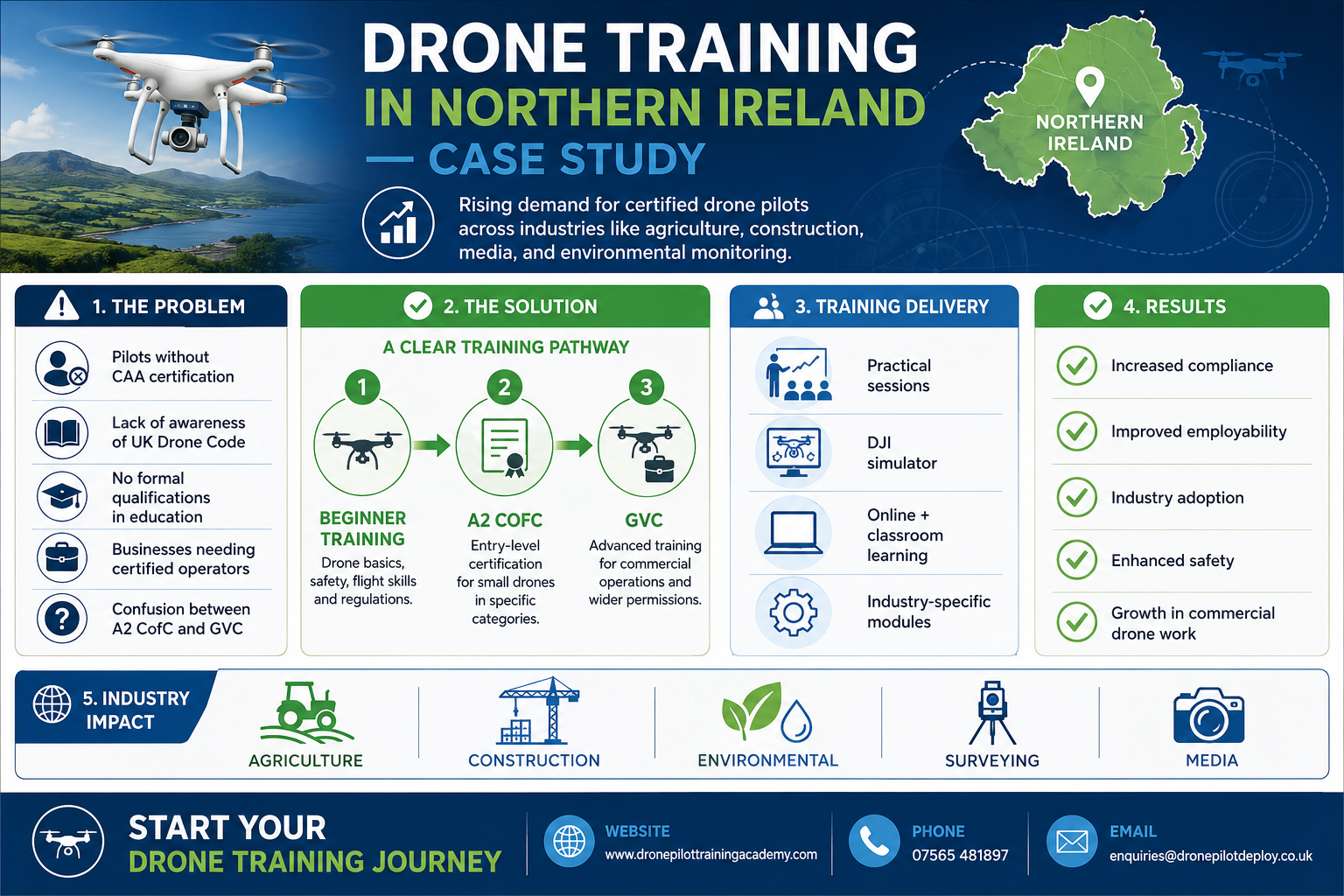
In early 2026, Drone Pilot Training Academy identified a clear skills gap:
Many individuals and businesses were using drones, but lacked the required CAA certificates of competency to operate legally and commercially.
Common issues included:
Pilots flying without a Flyer ID or Operator ID
Organisations unaware of CAA requirements
Students leaving education without recognised drone qualifications
Businesses needing certified pilots for inspections, mapping, and data capture
Increasing demand for A2 CofC and GVC certification
To address this, the Academy launched a structured training pathway designed to support beginners, hobbyists, and professionals.
The Challenge
Northern Ireland’s drone sector was expanding rapidly, but:
Many pilots did not understand UK airspace rules
Businesses required certified operators for insurance and compliance
Colleges and universities lacked formal drone qualifications
Industries such as agriculture, construction, and environmental science needed trained pilots
Individuals were unsure which certificate (A2 CofC or GVC) they needed
There was a clear need for accessible, high‑quality, CAA‑approved training.
The Solution: A Structured Drone Training Pathway
Drone Pilot Training Academy developed a complete training model that included:
1. Beginner Drone Pilot Training
A hands‑on introduction covering:
Drone safety
UK Drone Code
Pre‑flight checks
Basic flight skills
RTH, IMU, compass, and gimbal calibration
NI airspace rules
This ensured new pilots gained confidence before progressing to certification.
2. A2 Certificate of Competency (A2 CofC)
Ideal for:
DJI Mini, Air, and Mavic users
Low‑risk commercial operations
Pilots needing to fly closer to people
The A2 CofC became the most popular entry‑level certificate among students and small businesses.
3. General Visual Line of Sight Certificate (GVC)
Designed for:
Professional drone pilots
Surveying, mapping, inspections, agriculture, media
Organisations requiring an Operational Authorisation
The GVC enabled pilots to operate heavier drones and complete complex commercial work.
Implementation
Training was delivered across Northern Ireland, with a focus on:
Practical flight sessions
DJI Flight Simulator training
Classroom and online learning
Real‑world operational scenarios
Industry‑specific modules (agriculture, surveying, inspections, environmental work)
The Academy ensured every pilot understood:
CAA regulations
Airspace classifications
Risk assessments
Operational planning
Safe and compliant drone operations
Results
The training programme produced measurable outcomes:
✔ Increased compliance
Pilots obtained the correct CAA certificates, reducing legal and insurance risks.
✔ Improved employability
Students and professionals gained qualifications recognised across the UK and Ireland.
✔ Industry adoption
Businesses in agriculture, construction, and environmental sectors integrated drones into daily operations.
✔ Enhanced safety
Pilots demonstrated stronger understanding of airspace, risk management, and operational procedures.
✔ Growth in commercial drone work
Certified pilots secured work in:
Mapping and surveying
Agricultural monitoring
Media and cinematography
Environmental and conservation projects
Infrastructure inspections
Industry Impact
This case study demonstrates how structured drone training can support Northern Ireland’s growing demand for:
Skilled drone pilots
Digital mapping and GIS professionals
Agri‑tech and environmental specialists
Surveying and inspection teams
Media and creative industries
As drone adoption accelerates, CAA‑approved certification is becoming a core requirement, not an optional extra.
Conclusion
Drone Pilot Training Academy successfully addressed a critical skills gap by providing accessible, professional, and CAA‑approved drone training across Northern Ireland. Through beginner training, A2 CofC certification, and GVC commercial qualifications, the Academy helped individuals and organisations operate safely, legally, and confidently in a rapidly evolving industry.
The demand for certified drone pilots continues to grow — and structured training remains essential for anyone wishing to fly commercially or professionally.
Learn More
If you’re ready to begin your drone training journey, explore our full range of courses:
👉 www.dronepilottrainingacademy.com
Or contact us directly:
📞 07565 481897
📧 enquiries@dronepilotdeploy.co.uk
The body content of your post goes here. To edit this text, click on it and delete this default text and start typing your own or paste your own from a different source.