Case Study: The Future of Agriculture & Environmental Careers may be Taking Off at Greenmount Campus
Robert Dobbin • May 18, 2026
Agriculture, land management, and environmental science are changing faster than ever — and drone technology is now at the centre of that transformation. Across Northern Ireland, farms, agri‑tech companies, environmental agencies, and surveying teams are increasingly relying on drones to improve efficiency, reduce costs, and gather high‑quality data that simply wasn’t possible a decade ago.
Yet despite this rapid growth, many students still leave education without the recognised commercial drone qualifications required to operate safely, legally, and professionally in real‑world industry settings.
Greenmount Campus now has a unique opportunity:
to become Northern Ireland’s leading centre for professional drone education across agriculture, environmental management, and land‑based careers.
⚠️ Important Note: A Future Opportunity, Not a Current Programme
The drone‑training pathway described in this article is not currently offered at Greenmount Campus.
It represents a forward‑looking proposal — a realistic model of what could be achieved if the campus chose to integrate CAA‑approved drone qualifications into its agriculture, environmental, and land‑based programmes.
Everything outlined below is an example of what is possible based on industry demand, emerging technologies, and the growing need for drone‑skilled graduates across Northern Ireland.
With the right support, partnerships, and curriculum development, Greenmount Campus could become a leader in professional drone education — but this would require formal adoption by the institution.
🌱 Why Drone Skills Matter for the Next Generation of Land‑Based Careers
Modern agriculture and environmental work now depend heavily on digital tools — and drones are at the heart of this shift. They allow students and professionals to collect accurate, repeatable data that supports:
Precision farming
Livestock monitoring
Soil and crop analysis
Environmental impact assessments
Habitat and biodiversity surveys
Forestry and woodland management
Flood‑risk and erosion monitoring
GIS and mapping workflows
These are no longer “future skills” — they are current industry expectations.
Employers increasingly look for graduates who can operate drones safely, understand data capture, and work within UK CAA regulations. Without recognised qualifications, students face barriers to employment and cannot legally conduct commercial drone operations.
🎓 The Gap: Students Are Using Drones — But Without Certification
Many colleges and universities across the UK now incorporate drones into teaching, but very few provide formal CAA‑approved qualifications such as:
A2 Certificate of Competency (A2 CofC)
General Visual Line of Sight Certificate (GVC)
These are the industry‑standard certifications required for commercial drone work.
Students may gain experience flying drones during practical modules, but without these qualifications they cannot:
Operate commercially
Work on paid projects
Support research requiring regulated drone use
Apply drone skills in professional settings
Meet employer expectations in agri‑tech, surveying, or environmental roles
This creates a clear skills gap — and an opportunity for Greenmount Campus to lead.
🚀 A New Opportunity for Greenmount Campus
Greenmount Campus is already recognised as a centre of excellence for agriculture, horticulture, environmental management, and land‑based training. Adding CAA‑approved drone qualifications would strengthen:
1. Employability
Students graduate with industry‑ready certification recognised across the UK and Ireland.
2. Practical Learning
Drone operations enhance fieldwork, mapping, surveying, and environmental monitoring.
3. Industry Partnerships
Agri‑tech companies, environmental consultancies, and government agencies increasingly require drone‑skilled graduates.
4. Research Capability
Drones support data‑driven research in soil health, biodiversity, crop performance, and climate resilience.
5. Future‑Focused Curriculum
Drone skills align perfectly with the direction of modern agriculture and environmental science.
Greenmount could become the first land‑based campus in Northern Ireland to embed professional drone qualifications directly into its programmes — if the opportunity is pursued.
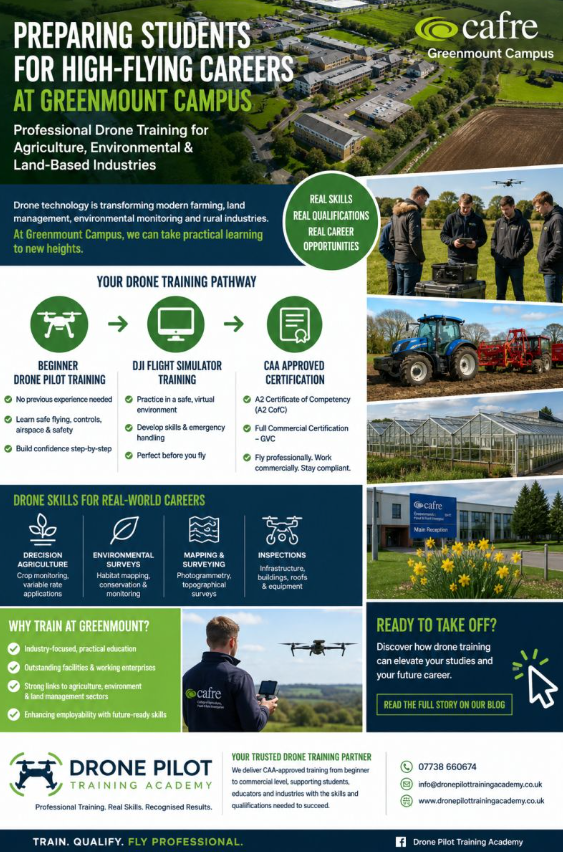
🛠️ What Drone Training Could Look Like at Greenmount
A complete pathway could include:
Beginner Drone Pilot Training
Hands‑on introduction to drones, safety, flight skills, and basic data capture.
DJI Flight Simulator Training
Safe, controlled environment for students to build confidence and competence.
A2 CofC Certification
Ideal for students beginning their journey into commercial drone operations.
GVC Certification
Full commercial qualification enabling students to work professionally across agriculture, surveying, and environmental sectors.
Specialist Workshops
Photogrammetry
LiDAR
GIS integration
Crop and soil analysis
Environmental monitoring
Mapping and modelling
This creates a complete, industry‑aligned learning experience.
🌍 Real‑World Applications for Students
Drone technology is already transforming:
Agriculture – crop health mapping, livestock monitoring, precision spraying
Environmental Science – habitat surveys, peatland monitoring, biodiversity assessments
Forestry – canopy analysis, tree health monitoring, woodland mapping
Land Management – erosion studies, drainage planning, landscape analysis
Agri‑Tech – data‑driven decision‑making, automation, digital mapping
Surveying & GIS – orthomosaics, 3D models, digital elevation models
These are the careers students are stepping into — and drone skills give them a competitive advantage.
🏫 Why Greenmount Is Perfectly Positioned to Lead
Greenmount Campus already delivers:
Practical, hands‑on learning
Strong industry links
Real‑world fieldwork
Modern facilities
A focus on innovation and sustainability
Adding CAA‑approved drone training would strengthen its reputation as a forward‑thinking, industry‑aligned campus preparing students for the future of land‑based careers — if implemented.
📈 The Future Is Digital — And It’s Already Here
Drone technology is no longer optional in agriculture and environmental work. It is becoming a core skill, just like GIS, machinery operation, or environmental surveying.
By integrating drone training into its curriculum, Greenmount Campus could:
Enhance student employability
Support industry needs
Strengthen research capability
Lead innovation in Northern Ireland’s land‑based sectors
The question is no longer “Should drones be part of education?”
It’s “How quickly can we prepare students for the industries that already depend on them?”
🔗 Take the Next Step
If you’re exploring how drone training could be integrated into agricultural, environmental, or land‑based education, we’d be delighted to support you.
Visit Drone Pilot Training Academy to learn more about our A2 CofC, GVC, and specialist drone training for colleges, universities, and industry partners.
👉 www.dronepilottrainingacademy.com
The body content of your post goes here. To edit this text, click on it and delete this default text and start typing your own or paste your own from a different source.