Case Study: Why Universities Across Northern Ireland Should Embed CAA‑Approved Drone Training in 2026
Robert Dobbin • May 14, 2026
🎓 Sector
Higher Education — Northern Ireland
Background
Drone technology is rapidly becoming a core tool across university teaching, research, and fieldwork. From archaeology and geography to engineering, surveying, environmental science, planning, and agriculture, drones are already embedded in academic practice.
But there is a critical gap.
Many students graduate having used drones, yet without any formally recognised CAA qualifications.
This limits employability, restricts compliant operational use, and forces employers to invest in additional training once graduates enter industry.
Northern Ireland's universities now have a unique opportunity to bridge this gap by partnering with a Belfast drone training academy delivering CAA-recognised qualifications.
Challenge
Universities needed a way to:
Ensure drone use in teaching and research is fully compliant
Equip students with industry‑recognised qualifications
Strengthen graduate employability across multiple sectors
Align academic learning with real‑world operational standards
Support fieldwork, research, and practical modules with trained, qualified operators
The question was no longer “Should we use drones?”
It became “How do we integrate them properly and compliantly?”
Solution Delivered
Drone Pilot Training Academy developed a structured approach for embedding CAA‑approved drone qualifications into university programmes.
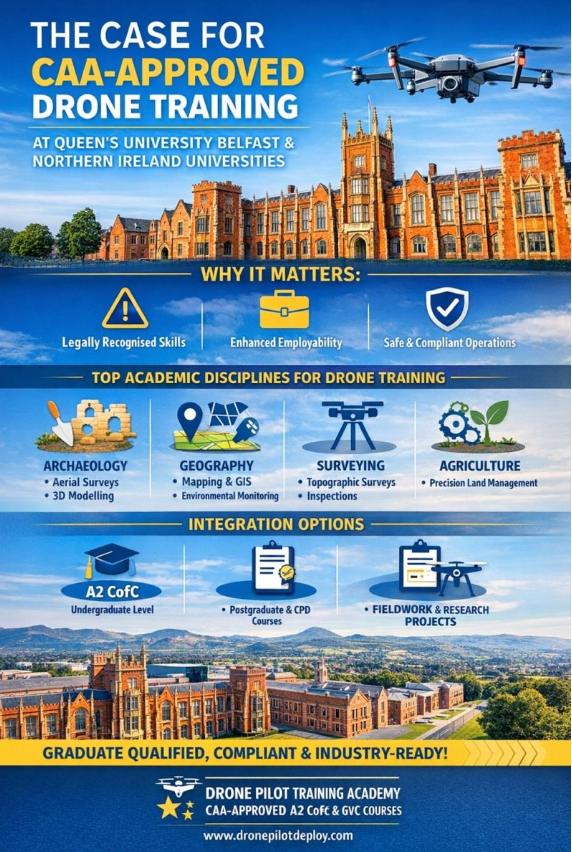
1. A2 CofC Integration (Undergraduate Level)
A low‑risk, accessible introduction to:
Airspace
Drone safety
Operational awareness
Basic compliance
Ideal for undergraduate modules, fieldwork, and research methods.
2. GVC Integration (Postgraduate or Advanced Level)
Delivered as:
Professional/employability modules
Short accredited courses
CPD or micro‑credentials
Embedded training within fieldwork or final‑year projects
This equips students with full operational authorisation capability.
Academic Disciplines Benefiting
CAA‑approved drone training aligns naturally with:
Archaeology — aerial surveys, photogrammetry, heritage monitoring
Geography & GIS — environmental monitoring, spatial data capture
Surveying & Civil Engineering — topographic surveys, inspections
Environmental Science & Planning — habitat analysis, flood risk, land assessment
Agriculture & Agri‑Tech — precision crop and land management
This creates a consistent, compliant foundation across multiple schools and faculties.
Impact on Universities
By embedding A2 CofC and GVC training, universities can:
✔ Produce graduates with legally recognised, industry‑ready skills
✔ Ensure all drone use in teaching and research is fully compliant
✔ Strengthen employability across construction, surveying, engineering, environmental, and agri‑tech sectors
✔ Enhance applied research capability
✔ Improve alignment with industry expectations and regulatory standards
Universities adopting this approach are already seeing stronger student outcomes and improved industry engagement.
Outcome
Universities that embed CAA‑approved drone training are now:
Producing graduates who are qualified, not just experienced
Strengthening their research capability
Enhancing industry collaboration
Increasing the value of fieldwork and practical modules
Positioning themselves as leaders in modern, technology‑enabled education
Northern Ireland has an opportunity to lead the UK in producing graduates who don’t just use drones — but graduate qualified, compliant, and ready for industry.
Conclusion
Drone technology is no longer optional in higher education.
It is becoming a core skill across multiple disciplines, and universities that embed CAA‑approved training will deliver stronger graduates, stronger research, and stronger industry partnerships.
📩 If you are an academic, School Lead, Employability Team, or programme manager exploring ways to enhance:
graduate employability
applied research capability
industry collaboration
Contact Robert Dobbin at Drone Pilot Training Academy to discuss how CAA‑approved drone training can be integrated into your programmes.